
Peer Review:
- Definition
- Peer-Review
- Review Decision
- Revision
- Appeal on Declined or Rejected Article
- Draft Copy
- Note for Reviewers and Referees
- Recommended Reviewers and Referees
- Threshold of Articles Per Issue/Volume
Definition:
A reviewer or referee is a specialist in a particular domain who provides detailed feedback on the research to the Editor.
In double-blind peer review, reviewers advise editors on revisions and publication priority, but editors decide. The Editors screen submissions against journal standards, sending suitable articles to experts and rejecting others, often for limited general interest1,2.
Every article undergoes double-blind peer review, keeping author and reviewer identities confidential. Reviewers advise editors on revisions and publication priority; editors then decide whether to accept or reject the article and set any conditions1.
Peer Review:
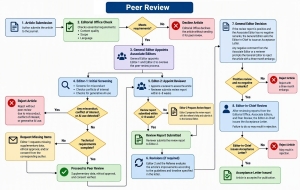
The journal abides by the following peer-review process:
- The Editorial Office checks that the article meets the journal’s essential requirements, including content quality, scope, and language. If it does not, the office declines the article without sending it for peer review.
- The General Editor appoints Associate Editors (Editor-1 and Editor-2) to oversee the peer-review process.
- Editor-1 screens for misconduct, conflicts of interest, and generative AI use; any findings result in rejection without peer review. Editor-1 also verifies technical requirements, including supplementary data, ethical approval, and consent, and requests missing items from the corresponding author.
- Editor-2 appoints a reviewer to assess the article and submit a review report within 6-8 weeks. If the reviewer fails to submit the review report within this timeframe, Editor-2 prepares the review report with the referee’s help and submits it to the General Editor.
- For revisions, Editor-2 and the Referee evaluate the article’s improvements according to the guidelines and timeline specified in the letter.
- If the review report is positive and the Associate Editor has no negative remarks, the General Editor asks the Editor-in-Chief to issue an Acceptance Letter. Any negative comment from the Associate Editor or a reviewer prompts the General Editor to reject the article with a three-month embargo.
- After reviewing reports from the Editorial Office, Associate Editors, and Peer Review, the Editor-in-Chief issues the Acceptance Letter. Failure to do so may result in rejection.
Review Decision:
Once the reviewer reports have been reviewed, the editor will decide on the following options:
- Accepted: No revision/correction is required.
- Revision/ Correction: Amend the article to address some concerns. Rewrite the article to identify necessary corrections and make further improvements.
- Decline: Article does not meet the requirements.
- Rejected: Lack of novel approach, Advancement, or technical errors. Further work might justify a resubmission.
Revision:
At the editor’s request, authors will be invited to revise their article by the deadline stated in the decision letter. The Associate Editor and a referee will assess the revision. Submit it using the revision link in the letter, along with details of the improvements to the referee—not as a new article.
Appeal on Declined or Rejected Article:
Authors can ask editors to reconsider a rejected article, but appeals are given lower priority and may take a few weeks. Only one request is allowed per article after peer-review, and the editor makes the final decision. Appeals are considered only if the original decision was significantly wrong due to factual errors or referee/reviewer bias. If an appeal is valid, the editor may request another peer-review of the updated article.
Draft Copy:
Once all editorial concerns have been resolved, the article is accepted for publication. The date listed indicates that it passed the quality check on its first submission, while the acceptance date marks when the editor sent the acceptance letter. After acceptance, the author submits a camera-ready proof (the final article). Only the title, scientific inaccuracies, or author list may be changed, and only with prior approval from the publishing team. The journal determines the style and size of figures.
Note for Reviewers and Referees:
Don’t share their information or ideas before publication, and destroy your copies. Disclose any assistance in your comments to the editor, maintain confidentiality, and disclose any AI use, noting its potential flaws or bias3. Respond promptly with constructive, honest, and polite feedback. Declare any competing interests that could affect your evaluation, and recuse yourself.
Reviewers and Referees should notify the editor directly of any concerns affecting the review, including inflammatory content, scope, validity, improvements, statistics, uncertainty, originality, clarity, methodology, outcomes, or references. Submit evidence-based reports and questions to the chief editor. The journal remains neutral on jurisdictional claims and naming conventions. Authors may choose their names; changes are requested only for scientific clarity.
Recommended Reviewers and Referees:
The journal does not accept recommended reviewers or referees. The journal has a specific reviewer policy.
Threshold of Articles Per Issue/Volume:
Balancing quantity and diversity is essential to maintaining the content’s integrity and relevance for readers. Article counts per issue or volume depend on publication frequency, submission volume, and acceptance rates. Monthly journals typically publish more articles than quarterly journals; consider these factors when assessing content breadth and scholarly relevance. To improve publication quality and ensure a wide range of ideas and voices, each issue should feature 2-25 articles. Each volume should comprise 25-150 articles.
References: